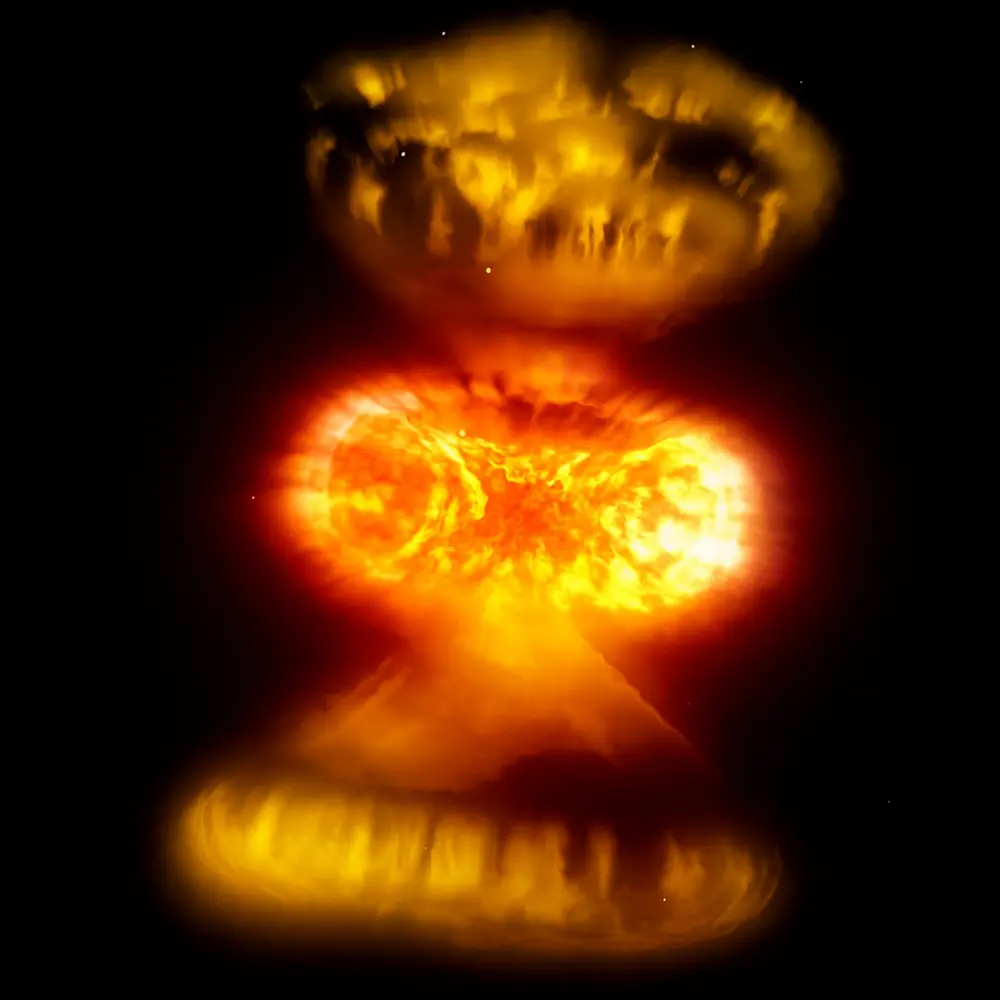
When a nova erupts, it’s often described as a single dramatic blast—but new observations suggest the real story is far more complex. In a recent Nature Astronomy paper, an international team used the CHARA Array’s cutting-edge infrared interferometer to capture the most detailed early images of two nova explosions to date. Their results reveal that nova ejecta can emerge in multiple distinct outflows, sometimes colliding to produce high-energy gamma rays, while other systems eject most of their material only weeks after the initial eruption. These findings provide rare, direct evidence that nova eruptions unfold through layered, time-dependent processes rather than a single instantaneous event.

The study includes contributions from Kirill Sokolovskii, a former postdoctoral researcher at the University of Illinois Urbana-Champaign, now at Texas Tech University, who coordinated multiwavelength observations that helped interpret CHARA’s unprecedented images.
Below, Kirill shares additional insight into the discovery and what it means for the future of Nova Research.
From your perspective, what is the most novel or important takeaway from these observations, especially for readers who may not work on novae?
The main takeaway from this work is that a nova event is more complex than a single explosion. Nova ejecta has structure, and the ejection process takes time - it's not a on-off event.
What made it possible to image these multiple outflows now, when this hadn’t been done before?
Images of a nova eruption that resolve multiple outflows became possible thanks to recent technological advances in infrared interferometry, good coordination among the observers, and luck. The recently upgraded sensitive Michigan InfraRed Combiner-eXeter instrument combines light from six 1-m telescopes of the CHARA array, providing baselines up to 330m. However, even with the upgraded sensitivity, the array can image only bright near-infrared sources (H band magnitude ~< 8).
Only a few Galactic novae reach that brightness, and a tight coordination between astronomers studying novae and operating the array was necessary to perform the interferometric observations once a nova appeared that was sufficiently bright in the region of the sky reachable to CHARA. The observations had to be organized on short notice before the expanding nova ejecta became too large and dim to be imaged.
Can you briefly describe your specific role in the study and how you contributed to the observations or analysis?
I was coordinating multi-wavelength observations of the two novae with facilities including NuSTAR, Swift (X-ray), VLA, and VLBA (radio). The CHARA array was an unconventional addition to these facilities, delivering the most exceptional results. My role in preparing the CHARA paper involved interpreting the CHARA results within a multi-wavelength context.
Was there a moment during the research when the results surprised you or exceeded expectations?
I was really surprised to see the polar outflow emanating from the central bright region in V1674 Her. While this structure was expected from VLA imaging and spectral line profile modelling in other novae, this is the first time such a structure has been imaged clearly.
What do you see as the most exciting implication of this work for future nova studies?
Interferometric imaging opens up a new channel of information on novae. First, we may learn about the structure of the nova outflow in the first days of the eruption. Second, we can measure distances to novae by comparing the rate of nova envelope expansion in the plane of the sky (as imaged via interferometry) with the expansion velocity derived from optical spectroscopy via the Doppler effect. Many novae do not have accurate distance measurements associated with them, as in quiescence, they are too faint and too distant to have a reliable Gaia parallax measurement.