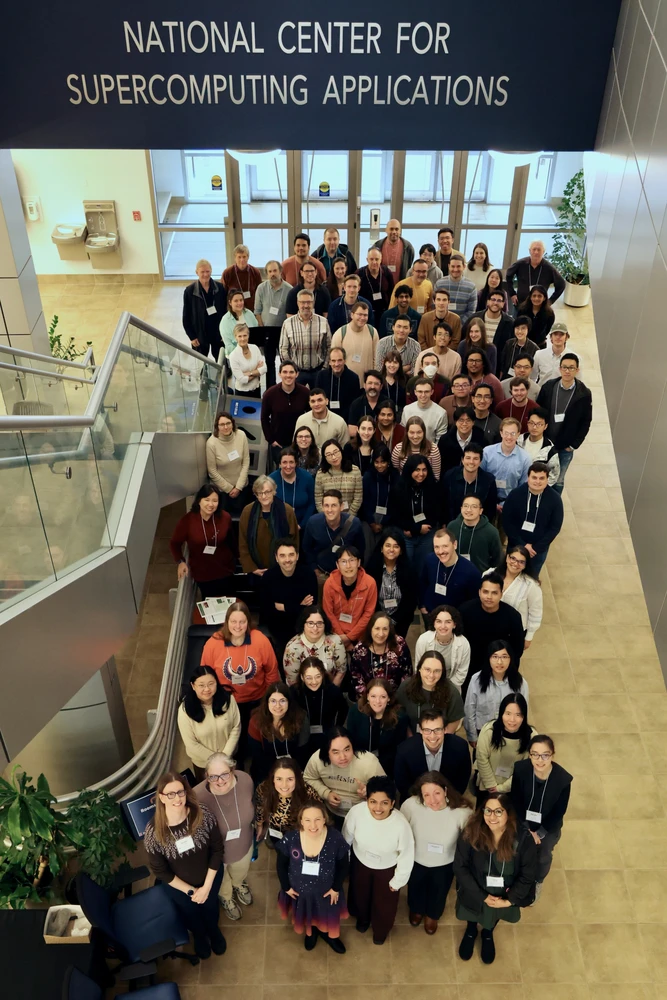
The Department of Astronomy hosted the conference "The End of Star Formation" at NCSA in March 2026. The conference focused on how galaxies stop forming stars, the roles of black holes, supernovae, outflows, and jets, and new insights from modern observational facilities and computational techniques.
92 participants from around the world attended, with talks, poster presentations, and discussion sessions. Travel support, funded by grants from the North American ALMA Science Center and the Royal Astronomical Society, enabled increased participation, particularly among junior scientists.
Highlights from the program included presentations of recent results from Atacama Large Millimeter Array molecular gas studies spanning cosmic evolution, synergies with large optical ground-based telescopes and the James Webb Space Telescope, and results from the latest generation of cosmological simulations. Discussions focused on the roles of various physical mechanisms in shaping star formation, the contributions of low- and high-redshift studies, how these can be connected, and the ability of upcoming data and facilities to address these questions. Significant recent progress in this field has deepened understanding of rapid galaxy evolution at high redshift, the role of molecular, neutral, and ionized gas outflows even at low velocities, and the complex interplay between galaxy and supermassive black hole evolution.
Professor Decker French served as the lead of the local organizing committee and as a member of the science organizing committee. Gaspar Garza led event planning and organization. Professor Joaquin Vieira provided support through CAPS for hosting and running the event. Local graduate students and postdocs Karolina Garcia, Thinh Nguyen, Kedar Phadke, Margaret Shepherd, Mathilde Van Cuyke, Maggie Verrico, and David Vizgan provided logistical support and local guidance.