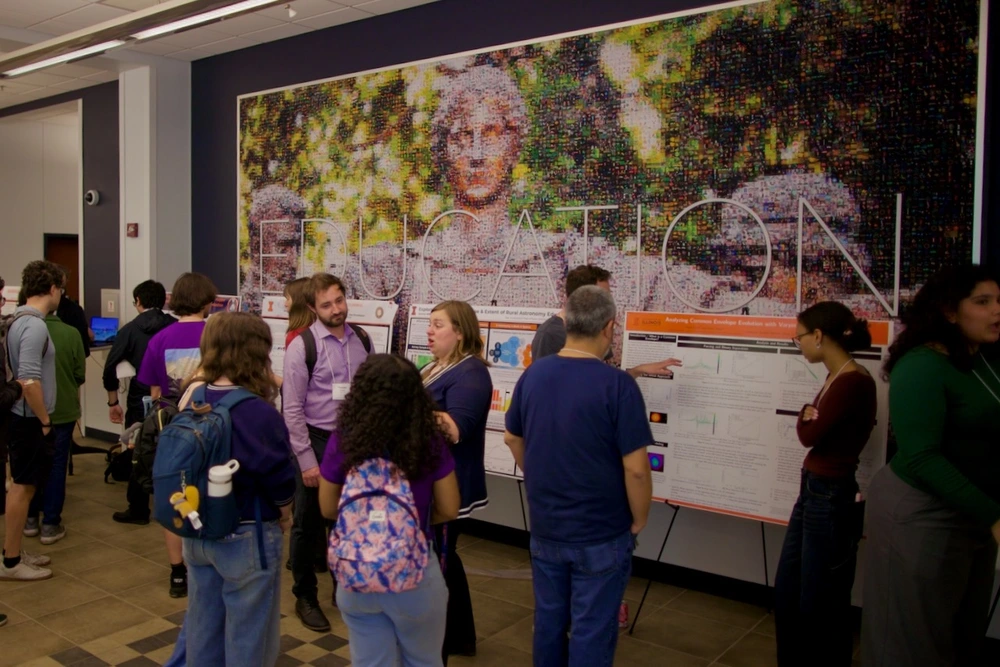
Researchers, students, and faculty gathered Friday, April 24, for Illini AstroFest, a daylong event designed to showcase astrophysics research, spark collaboration, and build community among scientists at every stage of their careers.
Held at the National Center for Supercomputing Applications, the event brought together participants from a wide range of disciplines, reflecting the increasingly collaborative nature of modern astronomy and space science. From early-morning coffee conversations to late-afternoon career discussions, AstroFest created space for both formal presentations and informal connections.
Showcasing research across campus
The day began with a poster session in the NCSA atrium, where undergraduate and graduate researchers presented their work alongside interactive demonstrations, including virtual reality and advanced data visualization projects. Attendees moved between displays, discussing everything from galaxy formation to computational modeling techniques.
That spirit of exploration—of trying new things and following evolving interests—was echoed throughout the day’s conversations. For many students, events like AstroFest offer a chance to see the wide range of paths available within and beyond astronomy.
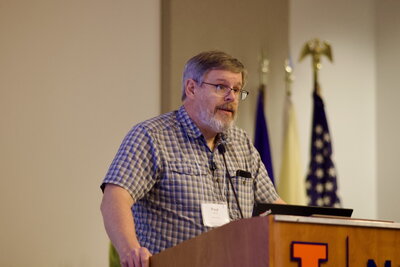
Following the poster session, attendees gathered in the auditorium for a series of plenary talks highlighting research across campus. Astronomy Professor Paul Ricker opened the session with remarks emphasizing the importance of interdisciplinary collaboration in tackling some of astronomy’s biggest questions.
Presentations throughout the morning spanned topics from space-based observation to large-scale survey design. Electrical & Computer Engineering professor Lara Waldrop discussed NASA’s Carruthers Geocorona Observatory, while physics professor emeritus Jon Thaler explored the challenges and opportunities of building large astronomical surveys. Aerospace professor Joseph Gonzalez offered insight into NASA’s recent Artemis II mission.
From uncertainty to opportunity
One of the highlights of the session was a talk by Britt Lundgren (Ph.D. ‘09), the now Philip G. Carson Distinguished Professor in the Sciences at UNC Asheville, titled “Growing Where You’re Planted.” Drawing on her own career path—from undergraduate research to postdoctoral work and a role in science policy—Lundgren reflected on the value of remaining open to opportunity, even without a clearly defined plan.
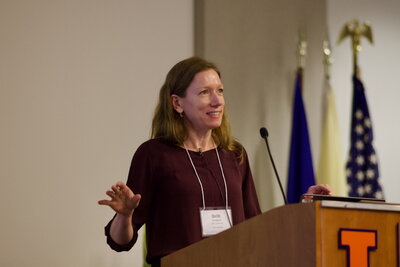
“I still didn’t know what I wanted to do,” Lundgren said of her transition out of college. “I applied to education programs, science policy programs, and astronomy programs. I thought, I can probably go back for education—it seems harder to come back into the sciences.”
That willingness to explore different directions ultimately shaped a career that bridges research, teaching, and policy. “I feel very lucky because the initial fork in the road I had—policy, education, and research—I’ve somehow managed to push all those back together,” she said.
After a midday break, the program shifted to a series of lightning talks, giving researchers a chance to present their work in quick, focused formats. A second poster session followed, continuing conversations from earlier in the day and allowing attendees to explore additional projects.
Throughout the afternoon, the event’s emphasis on accessibility and growth remained central—not only in the research presented, but also in the conversations between sessions. AstroFest was designed with early-career researchers in mind, encouraging participation and connection across departments and experience levels.
The event concluded with a career panel focused on “Life After Grad School,” featuring speakers from academia, research institutions, and industry, including Lundgren. Panelists discussed a range of career paths and offered practical advice for navigating transitions beyond graduate education.
“An astronomy degree is very transferable,” Lundgren said. “There are all of these astronomy-adjacent career paths where you can apply it in different ways.”