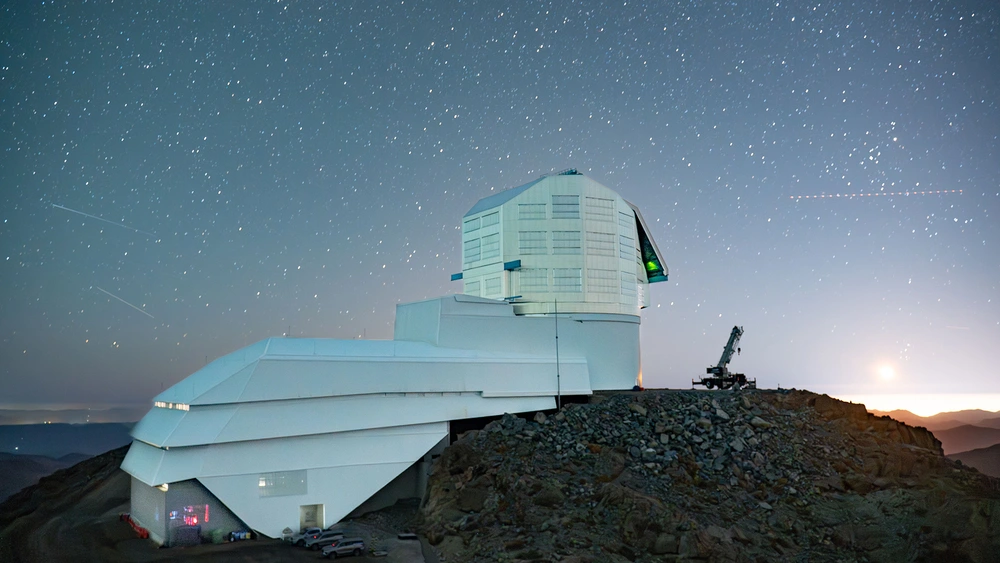
For astronomers, researchers and space lovers across the globe, the long wait is finally over.
Following approval from the U.S. National Science Foundation review board, the Legacy Survey of Space and Time (LSST) began its mission to create a decade-long movie of the southern sky by capturing large volumes of images and data from the Vera C. Rubin Observatory in Chile.
“The start of the LSST survey is the major milestone for Rubin Observatory that we have all been waiting for – some of us for decades,” said Gautham Narayan, spokesperson for the LSST Dark Energy Science Collaboration (DESC) and deputy director for astrophysics research at the NSF-Simons SkAI Institute. “Construction is substantially complete, and the telescope is delivering image quality close to its design specification, enough to carry out an extraordinary science program. For my team, that means mapping the time-domain sky and cataloging the different ways stars die, pairing Rubin with data from the Roman Space Telescope and the Euclid Space Telescope to probe the nature of dark energy and dark matter, and building AI models to analyze it all at scale. But Rubin will transform almost every area of astrophysics, so we’re really entering a golden era for survey science.”
Learn more about what the Rubin Observatory will do for astronomy