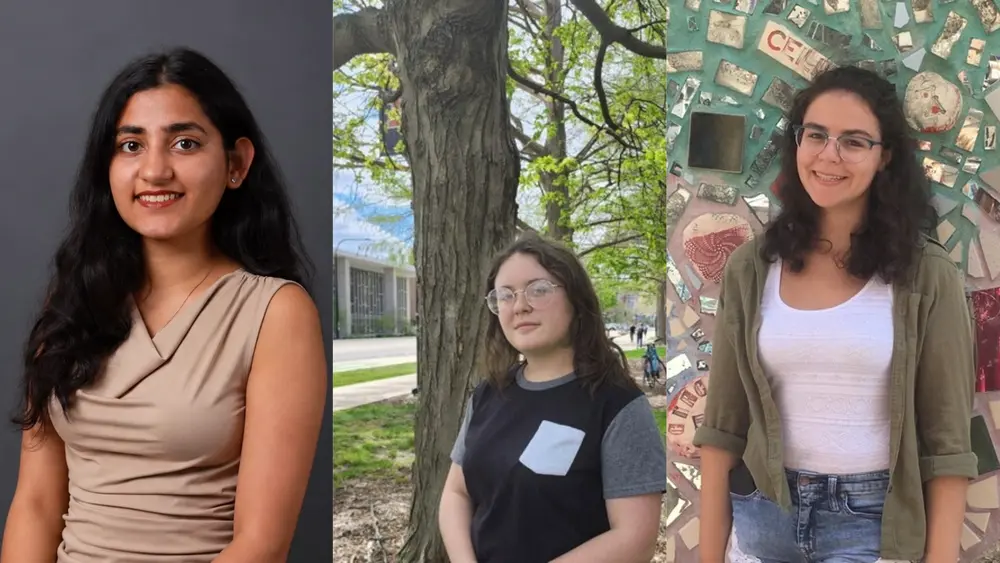
For Astronomy graduate students, spending several months working at a national laboratory can offer something difficult to find within the familiar environment of a university department: a chance to approach their research from a different perspective.
For Haille Perkins, it meant spending several months at Lawrence Berkeley National Laboratory working with researchers outside Illinois. Amanda Wasserman had a similar experience at Berkeley, while Aadya Agrawal is preparing to begin her own project at Fermi National Accelerator Laboratory.
All three Astronomy graduate students have participated in the Department of Energy’s Office of Science Graduate Student Research program, which places graduate students at national laboratories to work alongside researchers and gain expertise outside their university environment.
But the experience offered something beyond their individual research projects. For Haille and Amanda, stepping into a different research environment helped them think differently about the kind of work they wanted to do. Now Aadya is preparing to find out what several months at Fermilab might teach her.
A different place, a different way of working
For Haille, that meant working with Peter Nugent at Lawrence Berkeley National Laboratory on a new neural-network emulator technique for modeling supernovae.
Her research had previously focused on neutron star mergers, but she wanted to work with something that had already been observed. At Berkeley, she began modeling the nearby supernova 2023dbc to improve a model for simulating supernova physics more efficiently.
Working directly with Nugent gave Haille something difficult to replicate from a distance: immediate access to someone who could help interpret what she was seeing and figure out what to try next.
“I'm looking at this data, I've done this analysis, what does it mean?” Haille said. “And then Peter comes by, and he's like, consider the X, Y, and Z to do next.”
Amanda's project at Berkeley was similarly rooted in the practical problem of what to do with an enormous amount of incoming data.
The Vera C. Rubin Observatory's Legacy Survey of Space and Time is expected to find roughly 100 times as many supernovae as previous surveys. Amanda worked on a recommendation system that helps determine which supernovae are worth following up with spectroscopy, working with pipeline scientist Rob Knop to connect the system to real-time incoming alerts.
She had already encountered the opposite problem as an undergraduate, when she used the Dark Energy Spectroscopic Instrument to find rare, serendipitous supernovae hidden within galaxy spectra.
“In undergrad, I worked on AI systems to find these really needle-in-a-haystack supernovae,” Amanda said. “So then it was funny coming to grad school, and my new project is, well, now we have thousands of supernovae per night. We have so many, we don't even know what to do with it.”
Being physically at Berkeley changed how she could work, too. Rather than messaging a collaborator when she ran into a problem, she could simply turn around and ask.
“Being able to sit next to someone and hack on a coding problem can really make a difference,” Amanda said. “You can really speed up the process of work there.”
The benefits extended beyond their individual projects. Haille found herself surrounded by cosmologists, chemists, biologists, and researchers working on areas as far removed from astronomy as programming languages for thermodynamics. One researcher had spent about 20 years learning programming languages to build the tools he needed.
“I thought, I'm just going to go do astronomy,” Haille said. “And that was not at all what happened. I never thought that I would be hanging out with people in chemistry and biology. So it was very cool to see other sides of science.”
Finding out what comes next
Perhaps Haille's most consequential discovery wasn't about supernovae at all. While working at Berkeley, she realized that she enjoyed developing the computational tools behind the research.
“Fundamentally I just like developing tools,” she said.
Now she is applying for software engineering positions, including jobs at national laboratories.
Amanda's experience led her in the opposite direction.
Being away from Illinois meant being removed from the broader life of the department — helping run colloquia, contributing to Astronomy on Tap and taking part in the day-to-day work that keeps a research community functioning.
“And I missed that so much while I was there,” Amanda said.
That realization helped point her toward research operations. She is now an assistant director of research operations at SkAI Institute, a role that lets her work on the infrastructure and organization surrounding scientific research.
A different kind of next step
Their experiences illustrate one of the less obvious benefits of leaving the familiar environment of graduate school: sometimes it takes stepping away from what you know to figure out what you actually want.
Aadya is about to get her own opportunity to do that.
Beginning in November, she will spend roughly three months at Fermilab working with Alexandra Ćiprijanović to develop a pipeline for finding strongly lensed supernovae— rare events in which a foreground galaxy or cluster bends a supernova's light, producing multiple images of the same explosion.
The project grew out of Aadya's work with SkAI and her interest in a problem that was still relatively new when she began graduate school. Fermilab will give her access to expertise in lens modeling, simulation-based inference, and AI.
But she is also curious about something harder to quantify: what it will feel like to work in a different research environment.
“I would love to see what it's like when it's just researchers and how that national lab kind of functions,” Aadya said. “And the other part is just having access to people that are at the top of their field.”
Her experience will be somewhat different from Haille's and Amanda's. Fermilab is close enough that she expects to remain connected to Illinois and SkAI, rather than being completely removed from her department.
The three students encourage other graduate students to look for opportunities like SCGSR, even if they're not sure where they might lead.
“I'm hoping that gives me a different perspective on things and just like problem-solving skills in ways that I haven't been able to explore yet,” she said.