- Following the detection of the first gravitational wave event by LIGO on Sept. 16, 2015, the Dark Energy Survey team, including astronomers at Illinois, rapidly turned the DECam to that sky region to search for a visible light counterpart. No event was found, but is a model for future follow-ups.
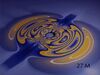 For the first time, scientists have observed ripples in the fabric of spacetime called gravitational waves, arriving at the Earth from the merger of black holes in the distant universe. This confirms a major prediction of Einstein’s general theory of relativity and opens a new window to the cosmos.
- Using new images that show unprecedented detail, scientists have found that material rotating around a very young protostar probably has dragged in and twisted magnetic fields from the surrounding area. Illinois astronomers Leslie Looney and Erin Cox lead the team studying the protostar.
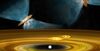 A detailed study of young stars and their surroundings has produced dramatic new evidence about how the dusty disks that are the raw material for planets grow. The team, led by Dominique Segura-Cox, found that the disks around some of the protostars are larger than some theoretical models predict.
- Catalogs of galaxies and stars derived from the data collected during the Dark Energy Survey’s science verification season prior to beginning official observations have been released to the public. Astronomy buffs can download the data from NCSA, which manages data processing and archiving for DES.
- Prof. Ben McCall has been elected as a Fellow to the Optical Society. Prof. McCall is being honored specifically for the development of ultrasensitive, ultrahigh resolution molecular ion spectroscopy methods that help elucidate chemical and physical conditions in interstellar clouds.