The National Center for Supercomputing Applications awarded Fiddler Innovation Fellowships to 38 University of Illinois Urbana-Champaign and NCSA graduate students in a ceremony on October 31 honoring their outstanding achievements and interdisciplinary contributions to NCSA programs, including Students Pushing Innovation (SPIN), NCSA’s Research Experiences for Undergraduates program titled “The Future of Discovery: Training Students to Build and Apply Open Source Machine Learning Models and Tools”, Design for America and those who worked with NCSA-affiliated faculty during the 2024-25 academic year and summer of 2025.
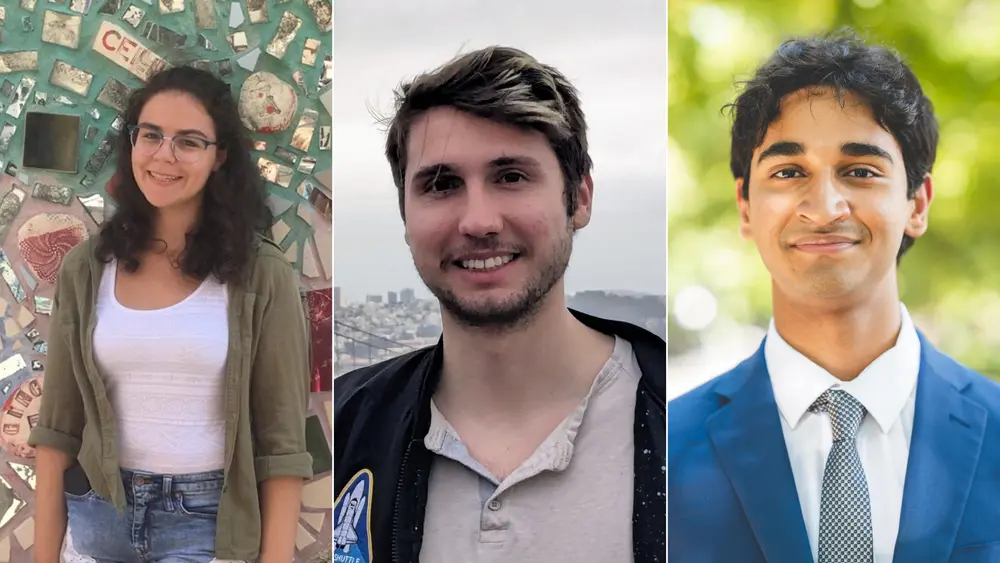
Three of these fellowships were awarded to students in astronomy or working closely with astronomy research groups.
Grant Merz

Grant Merz is a graduate student and SPIN Mentor for the Detection, Instance Segmentation, and Classification with deep learning project, working with professor Xin Liu. “DeepDISC uses computer vision AI frameworks to detect, segment, and classify objects in images from astronomical surveys,” Merz explained. “This application is crucial for cosmological analyses, studies of galaxy evolution and clustering, and more.”
Merz emphasized that the project’s success is rooted in collaboration, highlighting team members including former mentees Yichen Liu and Aarav Agarwal, postbaccalaureate research assistant Yash Ejjagiri, and intern Tia Kashyap. “Their contributions are numerous and significant, and it has been a privilege to work with them.”
Reflecting on the recognition, Merz added, “I am immensely grateful for receiving this fellowship and proud of how far DeepDISC and my mentees have grown. This fellowship will support me as I continue to engage in this exciting interdisciplinary research, mentor students, and engage with astronomers and computer scientists.”
Amanda Wasserman
Graduate student Amanda Wasserman works with professor Gautham Narayan’s Legacy Survey of Space and Time team. “The novel work we have accomplished on algorithms for classifying supernovae will be utilized by astronomers from around the world to conduct unprecedented science on objects that, in some cases, have only been theorized,” Wasserman said. “These algorithms will be applied to real data as early as December, as the LSST will observe the entire southern sky every three nights for ten years, reaching depths previously only accessible from telescopes observing in space.”
Wasserman shared that receiving the fellowship serves as a motivator: “Receiving this award is inspiring. It is a reminder that the work we are doing is contributing to interdisciplinary science and that there is a curiosity for the work we do, even outside the field of astronomy.”
She also highlighted the importance of mentorship in her career and in the LSST team’s work. “I greatly appreciate the recognition of the graduate student mentorship of remarkable undergraduates. I myself had many mentors throughout my career who inspired me to become the researcher that I am today. I hope not only that we have advised these students to the point that they are doing cutting-edge research, but that they have had a role model to become excellent mentors themselves in the future.”
Arjun Chainani

Arjun Chainani, an undergraduate majoring in computer engineering, works with professor Narayan on LSST anomaly detection and transient classification. The project aims to build machine-learning tools capable of identifying unusual or previously unobserved phenomena in the massive datasets LSST will produce.
“LSST will enable us to see unique objects with properties we’ve rarely studied, or sometimes never seen before,” Chainani explained, “and our goal is to harness state-of-the-art machine learning classifiers for identifying these potential anomalies in otherwise overwhelming amounts of data.”
Chainani shared that the fellowship will help him continue contributing to this rapidly developing area of research. “I’m really excited about the direction the project is headed, and I hope to help deploy it in the scientific community, where we can truly see its impact once LSST gets into full swing.”
“Receiving the Fiddler Innovation Fellowship is a huge honor! Jerry Fiddler has made numerous contributions to modern space technology. Learning about his journey, as well as his support of our project, really motivates me to continue exploring these unique interdisciplinary research fields throughout my undergraduate education.”
Together, these students exemplify the innovation and interdisciplinary collaboration celebrated by the Fiddler Innovation Fellowship. The Department congratulates them on this well-deserved recognition.