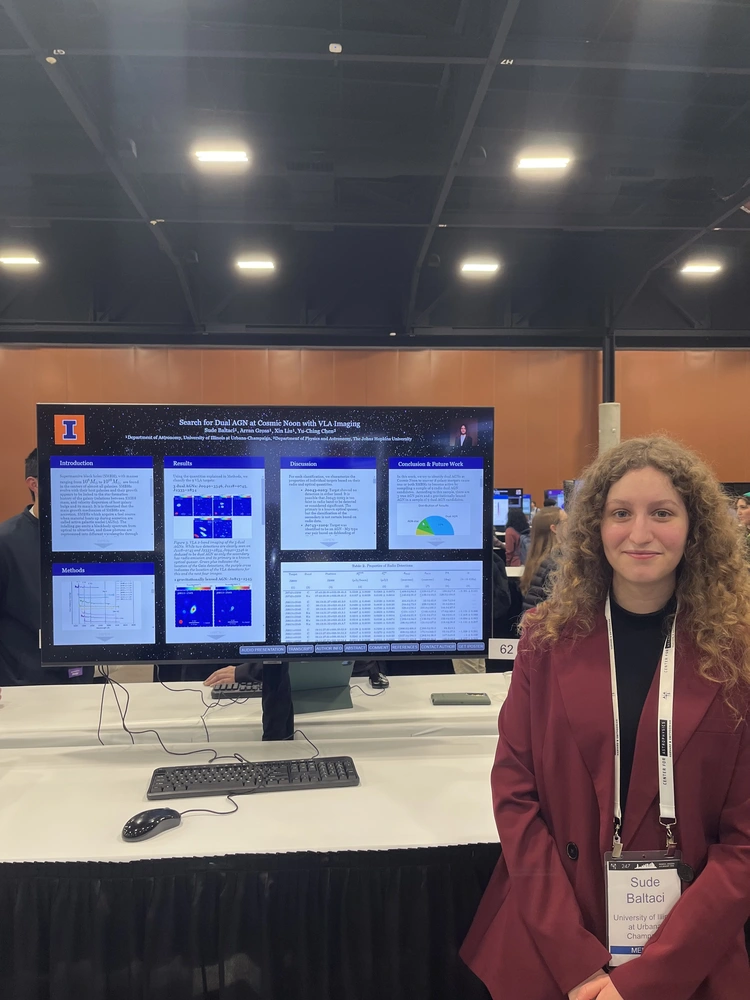
Sude Baltaci has been named a Chambliss Astronomy Achievement Student Award winner by the American Astronomical Society, recognizing the excellence of their poster presentation at the 247th AAS Meeting held this winter in Phoenix, Arizona. Baltaci is a fourth-year student majoring in astrophysics and minoring in mathematics.
The Chambliss Student Award is presented annually to a select group of undergraduate and graduate students whose poster presentations demonstrate exceptional research quality and clarity of communication. Baltaci’s award-winning poster focused on identifying dual active galactic nuclei (AGNs) in high-redshift galaxy mergers, a challenging and active area of astrophysical research.

“My poster was on identifying dual active galactic nuclei in galaxy mergers at high redshift,” Baltaci explained. “We used radio data to analyze the properties of the candidate pairs to understand if mergers are a significant mechanism for triggering dual AGNs.” By studying these rare systems, their work helps astronomers better understand how galaxies evolve and how supermassive black holes may be activated during cosmic collisions.
For Baltaci, the recognition represents more than a line on a resume. “Receiving the Chambliss Student Award allowed me to experience what is required to pursue high-quality research,” they said. “Preparing for the competition made me push to be better at my work, and the result made me realize how far I have come since my first year here—and how far I still have to go.”
Baltaci completed the project under the mentorship of postdoctoral researcher Arran Gross, and professor Xin Liu, whose guidance played a central role in shaping both the research and their development as a scientist. “Their guidance made it possible for me to start and pursue this project,” they noted. “I learned a lot from both of them about astronomy, as well as how to conduct and communicate research well. Their influence will stick with me for the rest of my career.”
Following the award, Baltaci is continuing to build on the project’s momentum. They are currently preparing a manuscript reporting the results, which will be submitted for publication soon. Although they are graduating this semester and plan to attend graduate school in a different area of astronomy, the work itself will continue. “The project will continue to have new dual AGNs added to the sample,” they said.
Baltaci’s recognition by the AAS highlights both the strength of undergraduate and graduate research within the department and the impact that strong mentorship and curiosity-driven inquiry can have early in a scientific career.