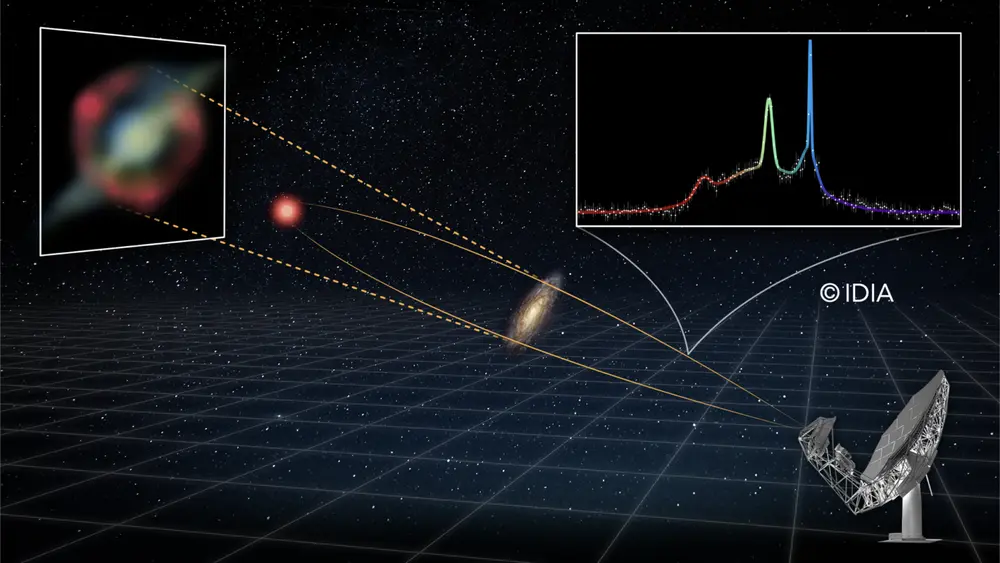
An international team of astronomers led by Dr. Thato Manamela at the University of Pretoria has identified the most distant hydroxyl (OH) megamaser ever detected — a powerful radio signal emitted by a merging galaxy more than 8 billion light-years from Earth. Athol Kemball, professor of astronomy at the University of Illinois Urbana-Champaign, is a member of the team reporting the discovery in a paper in Monthly Notices of the Royal Astronomical Society Letters.
Hydroxyl gas in galaxies can produce bright maser emission — similar to a laser, but at radio wavelengths. When this emission becomes extremely bright, it is known as a megamaser. These rare objects act as cosmic signposts, revealing critical details about galaxies in the early universe.
“This system is truly extraordinary,” said Dr. Thato Manamela, SARAO-funded postdoctoral researcher at the University of Pretoria and lead author of the new study. “We are seeing the radio equivalent of a laser halfway across the universe. Not only that, during its journey to Earth, the radio waves are further amplified by a perfectly aligned, yet unrelated foreground galaxy. This galaxy acts as a lens, the way a water droplet on a window pane would, because its mass curves the local space-time. So we have a radio laser passing through a cosmic telescope before being detected by the powerful MeerKAT radio telescope – all together enabling a wonderfully serendipitous discovery.”
The newly detected source dates back to a time when the universe was less than half its current age. Because of its extreme brightness, it may even qualify as a “gigamaser,” an even more luminous category. Gravitational lensing amplified its signal — an effect predicted by Einstein’s theory of general relativity — as a foreground galaxy bent and magnified light from a more distant object.
The research team made the discovery using the MeerKAT radio telescope in South Africa, a precursor to the future Square Kilometre Array. Data processing was provided by the Inter-University Institute for Data Intensive Astronomy (IDIA)
By identifying megamasers at such vast distances, astronomers gain a new tool for studying how galaxies evolved during a formative period of cosmic history. Astronomers expect systematic searches with next-generation radio telescopes to uncover many more of these distant beacons, providing deeper insight into galaxy mergers and the growth of supermassive black holes in the early universe.