Long before he was simulating the early universe, Illinois astronomy professor Kirk Barrow spent a summer teaching himself quantum physics from a borrowed textbook.
At the time, Barrow had graduated with a degree in aerospace engineering and was trying to convince faculty at the Georgia Institute of Technology to let him pursue a PhD in physics despite lacking the traditional background. One professor handed him a quantum physics textbook and told him to learn it before taking the program's entrance exams.
“He just gave me the book, and I had to read it over the summer and do all the problems and figure it out,” Barrow said.
By the time he returned it, the book had fallen apart.
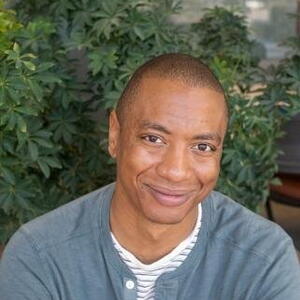
“I was a little embarrassed giving it back to him because I destroyed his book,” Barrow said. “It was in pieces.”
That drive to understand difficult questions eventually led Barrow toward astrophysics, where he now studies some of the universe’s biggest unknowns: the formation of the first stars, galaxies, and black holes after the Big Bang.
“We know the universe exists today, but if we don’t know how it came to be, what do we know?” Barrow said. “I can tell you there’s a galaxy in the sky, but if I don’t know how it formed, then I just know that it’s there.”
Barrow studies those questions through large-scale cosmological simulations — massive computational models that combine gravity, star formation, thermodynamics, and dark matter to recreate the evolution of the early universe.
He compares the process to “a gumbo or hot pot,” where researchers combine everything they know about the universe into a single simulation.
For decades, astronomers and physicists built theories about that distant era with little way to test them directly. The first galaxies and black holes were simply too far away — and too faint — to observe clearly.
“When you can’t see something, it’s a theorist’s playground,” Barrow said. “You create a million theories of things, and they could all be right as long as at the end of the theory you get what we have today.”
That began to change with the launch of the James Webb Space Telescope (JWST), which allowed astronomers to look deeper into space — and further back in time — than ever before.
A new view of the cosmos
Before JWST launched, much of Barrow’s field revolved around prediction. Researchers spent years building increasingly sophisticated simulations of the early universe, attempting to forecast what the telescope might eventually observe.
Then JWST began sending back images.
“JWST found things that are so wild, so different than anything we ever expected,” Barrow said. “100 students could earn PhDs just based on trying to figure out the things that we had no idea that we would see through the telescope.”
Many long-standing theories suddenly looked incomplete. Black holes appeared larger and older than expected. Galaxies formed earlier than some models predicted. For researchers studying the origins of the universe, the telescope transformed years of theoretical work into an urgent effort to reconcile simulations with reality.
That challenge now sits at the center of Barrow’s work.
“If you know how things start, then what’s the problem?” Barrow asked. “We should be able to figure out how everything came to be.”
But in practice, the process is far messier. Small differences in how researchers model physical processes — particularly around black holes and star formation — can dramatically change the galaxies that simulations produce.
Bridging theory and observation
One collaboration Barrow works with, the AGORA project — short for “Assembling Galaxies of Resolved Anatomy” — brings together nine major simulation groups from around the world to model the same galaxy using different software codes.
“What they found is you get nine different galaxies,” Barrow said. “The goal is to understand why that happened.”
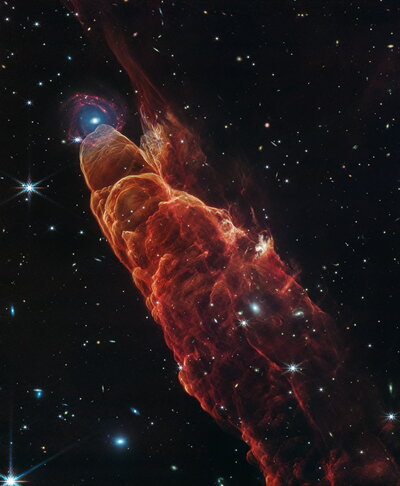
That work has become increasingly important as JWST observations challenge long-standing assumptions. One major mystery involves black holes that appear far larger and older than existing theories predicted.
“The black holes we see with the James Webb Space Telescope are a hundred, a thousand, 10,000 times larger than we’d predict,” Barrow said. “And there’s not enough time, even if it tried to gobble up everything that it could, for a typical black hole to grow that big.”
For Barrow, part of the challenge — and excitement — lies in bridging the longstanding divide between theorists and observational astronomers. Initially, he described that gap as “a chasm.”
“In theoretical physics, you don’t learn how to turn an observation into science,” Barrow said. “And astronomers don’t necessarily live in theory-land like we do.”
His own work in radiative transfer, which models how light moves through galaxies and telescopes before becoming an observable image, attempts to connect those worlds directly.
“The way to actually have that cycle — not just observe things, not just think about things — is to directly compare what we’re seeing with what we think we should see,” he said.
A collaborative future
To Barrow, the future of astronomy is collaborative. Many of his closest research partners are in Japan, where he completed a postdoctoral appointment in 2020 and developed a deep appreciation for both the research culture and the country itself.
Outside the lab, Barrow spent weekends exploring the country, including climbing Mount Fuji during the narrow window before the mountain closed for the season. Partway through the climb, more than 10,000 feet above sea level, he paused for a virtual research meeting before continuing toward the summit.
Today, Barrow regularly returns to Japan to work directly with colleagues multiple times a year and is affiliated with the Center for East Asian and Pacific Studies.
For Barrow, that same collaborative approach to research naturally extends to his work with students and his approach to
teaching.
Before graduate school, he spent years tutoring students in math and physics while trying to chart his own path into astrophysics — an experience he says fundamentally changed the way he understood learning and communication.
“Teaching is the highest form of learning,” Barrow said. “You become this person who can try to explain things from many different angles.”
Today, Barrow leads a research group of undergraduate and graduate students with backgrounds ranging from astronomy to computer science, often working with them one-on-one at a whiteboard. He says he enjoys learning alongside students as they develop expertise in areas ranging from observational astronomy to emerging computational techniques.
As new telescopes and observatories continue to expand astronomers’ ability to observe the distant universe, Barrow believes the field is entering another transformative period.
“We’re probably going to learn a ton about the universe over the next 10 to 15 years,” he said.
For Barrow, the sense of wonder that led him to wear out a quantum physics textbook in a single summer has never really disappeared. Despite spending his career studying some of the universe's biggest mysteries, he says he still hasn't lost sight of how remarkable it feels to be an astrophysicist.
“What kid thinks that that’s going to happen?”