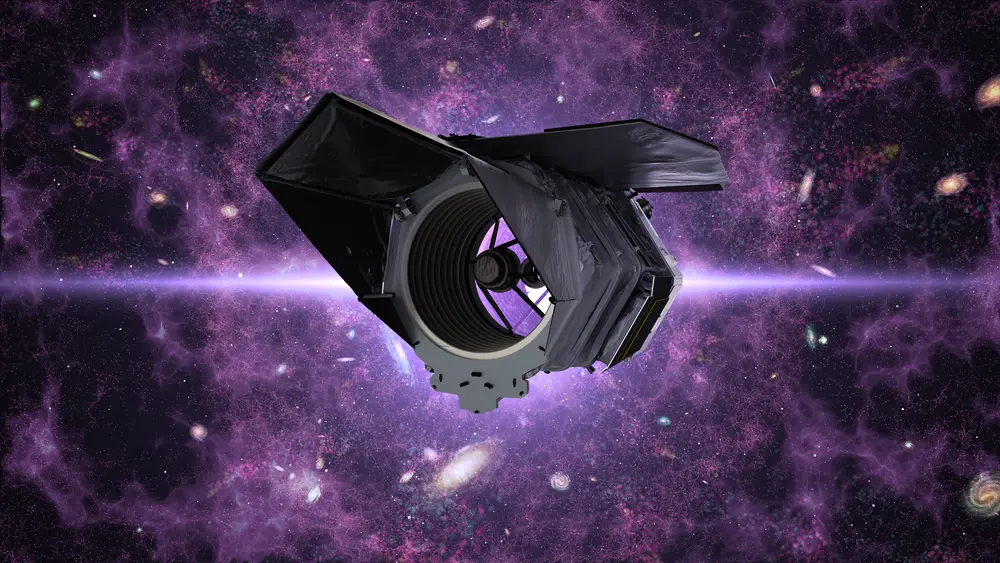
As the Nancy Grace Roman Space Telescope prepares to begin its first cycle of scientific observations, University of Illinois-Urbana-Champaign astronomers will be among the researchers using the new observatory to explore some of the biggest questions about galaxies, supermassive black holes, and the early universe.
Illinois Astronomy researchers have been selected for multiple programs in Roman's highly competitive first cycle, including projects led by Illinois graduate students and faculty, as well as participation in a major new observing program co-led by the University of Missouri, Space Telescope Science Institute, and the University of Illinois.
Launched this past Sunday, Roman, NASA's next flagship astrophysics observatory, will survey the infrared universe with a combination of sensitivity, resolution, and an enormous field of view. Its images will be comparable in sharpness to those produced by the Hubble Space Telescope, while covering a vastly greater amount of sky at once.
That combination will allow astronomers to study enormous numbers of distant objects while also repeatedly returning to the same regions of sky. The resulting data will support research ranging from the evolution of galaxies and supermassive black holes to the search for planets in our own galaxy.
"Roman is really a kind of survey telescope with sharp views as sharp as the Hubble Space Telescope, but a field of view that is more than 100 times bigger than Hubble," said professor Yue Shen. "Basically, you can imagine that you have more than 100 Hubbles observing in the sky at the same time."
Roman's first cycle includes both programs that will conduct new observations and programs that will analyze data from surveys already planned for the telescope. Illinois researchers will be involved in both types of science.
Weighing the universe's oldest black holes
Graduate student Zachary Stone will use Roman's repeated observations of the same regions of sky to study supermassive black holes in the early universe through a project titled "High-Redshift AGN Reverberation Mapping and Variability with Roman."
Almost every massive galaxy contains a supermassive black hole at its center, but astronomers still don't have a complete picture of how these enormous objects formed and grew.
One way to learn how black holes grow is to measure their masses at different points in cosmic history. If black holes in the younger universe were generally smaller than those in the older universe, for example, it could provide clues about how they formed and accumulated mass over time.
Stone's project will look back more than 10 billion years to study some of the oldest black holes in the universe. Roman will repeatedly observe selected regions of the sky, allowing researchers to track changes in the light emitted by thousands of active supermassive black holes.
Those changes can reveal information about the gas surrounding the black holes and allow researchers to estimate their masses. By measuring black holes at different points in cosmic history, Stone hopes to determine whether the earliest black holes behaved differently from their modern counterparts and learn more about how they grew.
"Modern space-based telescopes like Roman are finally suited to probe the oldest black holes in the universe," Stone said. "Estimating masses for even only a few percent of these black holes will tell us if these black holes function the same in the early universe as the current universe, and how they grew over time."
Stone has followed Roman's development for years and is excited to participate in its science from the beginning.
"I'm interested to see where this project leads me, and what unexpected results I'll find along the way," he said.
Probing the environments around distant black holes
Graduate student Padmavathi Venkatraman will use planned Roman observations to investigate the structure of active galactic nuclei, or AGN, through a project titled "Probing AGN structure using microlensing from z = 0.5 to z = 4.5."
At the center of many galaxies is a supermassive black hole surrounded by rapidly accreting matter, gas clouds, and thick rings of dust. This environment, known as an active galactic nucleus, can shine brighter than billions to even trillions of suns.
But AGN are so distant that astronomers cannot directly resolve their fine structure with conventional telescopes. Venkatraman's project will instead use gravitational microlensing — a phenomenon in which stars in a foreground galaxy act as tiny natural magnifying glasses for light from a more distant AGN.
"Stars act as smaller magnifying glasses, amplifying signals from different parts of an AGN," Venkatraman said.
By studying the effects of these natural cosmic lenses, the researchers can investigate different regions of distant black hole environments that would otherwise be impossible to resolve directly.
Roman's deep view of the distant universe and its observations across visible and near-infrared wavelengths will help the team build a large sample of gravitationally lensed AGN. The project will also benefit from complementary observations from other major surveys, including the Vera C. Rubin Observatory's Legacy Survey of Space and Time.
"I feel incredibly excited to have the opportunity to work with Roman's first cycle of observations," Venkatraman said. "I look forward to collaborating with a broad team of scientists to extract meaningful insights into the astrophysical processes that occur around black holes and their impact on the galaxy they reside in."
What shuts down a galaxy?
Graduate student Maggie Verrico, along with professor Decker French, will use data from Roman's High Latitude Wide Area Survey through their project, "A Census of AGN in Rapidly-Quenching Galaxies at Intermediate Redshift with Roman's High-Latitude Wide-Angle Survey," to investigate one of the major mysteries of galaxy evolution: What causes massive galaxies to stop forming stars?
Massive galaxies are generally classified as either star-forming spiral galaxies, such as the Milky Way, or elliptical "red-and-dead" galaxies that have stopped producing new stars. But astronomers still don't fully understand how galaxies make that transition.
"I'm using Roman to study galaxies 10 billion years in the past, just as they stop forming new stars to find signatures of these galaxy-killing processes," Verrico said.
One possibility involves the supermassive black holes at the centers of galaxies. As material falls toward a black hole, it can release enormous amounts of energy. That energy may heat gas within the galaxy, causing it to expand and preventing the dense clouds of gas needed to form new stars from collapsing.
Using Roman's large survey of distant galaxies, Verrico will investigate whether galaxies that hosted actively accreting supermassive black holes 8–10 billion years ago had less star formation than galaxies without active black holes. If so, it could provide evidence that black hole "feedback" helped shut down star formation in the massive elliptical galaxies we see today.
"The big question is what that energy does to the galaxy," said professor Decker French, who is collaborating with Verrico on the project.
The galaxies Verrico wants to study are both rare and extremely faint at such great distances. Roman's ability to observe large numbers of distant galaxies with high sensitivity will make it possible to investigate these populations in greater detail than before.
"I'm honored that my project was selected, and I look forward to getting my hands on the first sets of Roman data in the new year!" Verrico said.
French said she is particularly proud of the three Illinois graduate students, whose projects were selected for Roman's first cycle.
"I am extremely proud of Maggie, Zach, and Padma, who have shown strong scientific leadership in preparing these proposals, and who are well-positioned to make cutting-edge advancements with the new Roman data."
Pushing Roman to its limits
In addition to assisting Stone and Venkatraman, Shen is also a co-principal investigator on the Roman eXtreme Deep Field, one of Roman's Cycle 1 General Astrophysical Survey programs.
The project will use hundreds of hours of Roman observations to create an exceptionally deep survey of a region near the North Ecliptic Pole–the pole north of the equator. The survey will reach depths comparable to the famous Hubble Ultra Deep Field, but across an area more than 140 times larger.
That expanded view will allow researchers to find far more extremely distant galaxies, including rare, luminous galaxies from the universe's earliest eras, and investigate the emergence of the first cosmic structures and supermassive black holes. The field will also benefit from complementary observations from the James Webb Space Telescope and other facilities.
Shen uses the Hubble Ultra Deep Field to teach students about the early universe. He expects RXDF to offer a much larger view of that history — and eventually become a teaching tool for the next generation of astronomers.
“I teach in class, and I show students the Hubble Ultra Deep Field image,” Shen said. “But in a few years from now, we're going to replace that with what we get from this RXDF field. I'm going to show students how massively bigger these new observations will be, and they will surpass the original Hubble Ultra Deep Field legacy images.”